Selected Projects / Designing for Student Engagement
Designing for Student Engagement
Helping new students move from enrollment to confident, meaningful learning actions.
ROLE
Senior Product Designer
TIMELINE
3 months
CONTRIBUTIONS
Research · Product Design · Ideation Workshop
OUTCOME
~17% increase in first-month student On Track rate, measured over the following quarter.
Summary
Around 1 in 5 CareerFoundry students fell off track during their first month, consistently across courses. Onboarding gave students plenty of information, but not enough confidence to start learning.
As Senior Product Designer, I worked with the Product Owner, engineers and curriculum experts over three months to redesign early onboarding around relevant guidance, hands-on interaction and achievable learning goals. The released experience delivered an approximately 17% increase in first-month student On Track rate over the following quarter.
PROJECT OVERVIEW
The first major drop-off happened in the first month
Around 1 in 5 students fell off track during the first month after enrollment. Later drop-offs varied by course content and difficulty, making the first month the earliest shared opportunity to improve learning momentum across every course.
Our team's key metric was On Track rate: a student was on track when they submitted at least the expected number of weekly assignments.
Onboarding needed to help students navigate the platform, prepare required tools, submit assignments, access mentor and tutor support, and understand how to stay on track. Yet only 13.2% completed all recommended activities, and average confidence in meeting the weekly submission goal was 3.2/5. Based on this evidence, our team pitched improving onboarding as a Q3 initiative.
Key engagement barriers
- Important guidance was separated from the moment students needed it.
- Students struggled to remember and apply large amounts of information.
- Beginners underestimated the preparation required to use unfamiliar tools.
- Students working full-time struggled to establish realistic study routines.
- Generic onboarding did not reflect different experience levels, motivations, or goals.
- Students wanted to begin learning quickly and perceived lengthy onboarding as another barrier.
We needed to help students move from enrollment to active learning as quickly and confidently as possible.
Project goals
How might we help new students start learning confidently and stay on track from the beginning?
Instead of treating time spent in onboarding as engagement, we defined engagement through the actions that demonstrated students were becoming active participants in their learning experience.
- Understand how the study platform supports their learning.
- Know what to expect from the program.
- Be prepared with the tools and information needed to begin.
- Establish a realistic and measurable study goal.
- Feel confident taking their first step independently.
- Know where to find support when they need it.
As a new student, I want to complete a goal-oriented onboarding experience that helps me understand the platform, prepare for my course, and confidently begin learning.
Defining student engagement
For this project, engagement did not mean keeping students inside onboarding for longer. In fact, the opposite was true. A successful experience should help students leave onboarding and begin learning as quickly as possible. We looked at engagement as a progression:
Understand → Get ready → Start learning → Build a routine → Stay on track
This meant looking beyond onboarding completion toward behaviors such as:
- Completing meaningful platform actions
- Building out a student profile
- Preparing required tools
- Beginning course activity earlier
- Setting an achievable weekly learning goal
- Feeling prepared for the first submission
Initial hypotheses
Together with the Product Owner, I defined three hypotheses to guide our research.
1. Learning by doing would create stronger engagement than passive instruction. Rather than telling students what the platform could do, we believed that guiding them through essential actions would help them experience its value directly.
2. Early commitment would help students turn motivation into a habit. We believed that establishing an achievable learning goal during onboarding could give students an early commitment to work toward and make progress feel more concrete.
3. Relevant guidance would encourage students to participate. We believed that collecting information about students' backgrounds, motivations, and availability would allow the product to offer more relevant guidance and resources.
DISCOVERY
Surveying 212 students
Our onboarding survey received 212 responses. It revealed where students needed clearer support before starting their course.
Key findings
- 44% wanted a short, step-by-step platform tour, embedded directly within the product rather than provided as a separate document.
- 55.6% wanted a clear overview of the program timeline and important dates — understanding course structure was one of the most important factors in feeling prepared.
- 44% wanted clearer information about required tools and software, particularly beginners.
- Only 13.2% completed all recommended onboarding activities.
- Average confidence in meeting the weekly submission goal was 3.2/5.
Students were enrolling, but onboarding wasn't preparing them to start learning with confidence.
Going deeper through interviews
We interviewed 9 students across different courses. Three recurring struggles emerged:
1. Too much, too early. Students received information before it became relevant, so much of it was forgotten.
2. One onboarding experience didn't fit everyone. Backgrounds, confidence and goals varied widely. Beginners needed more preparation and reassurance, while generic guidance often felt irrelevant.
3. The preset weekly submission goal was hard to judge. New students didn't yet know how long different tasks would take, so they couldn't tell whether the suggested weekly goal was realistic.
Students didn't need more information. They needed the right information at the right moment. Relevant guidance made students feel more prepared to act.
Turning research into design principles
- Make it actionable Every onboarding step should help students complete a meaningful action rather than simply consume information.
- Provide guidance in context Information should appear when it becomes relevant, not weeks before a student needs it.
- Respect students' urgency Most students sign in because they want to begin learning. Onboarding should accelerate that goal rather than become another barrier.
- Adapt to different starting points A career changer with no previous experience needs different preparation from someone already working in the field.
IDEATION
Product opportunities mapping, where engagement could be supported
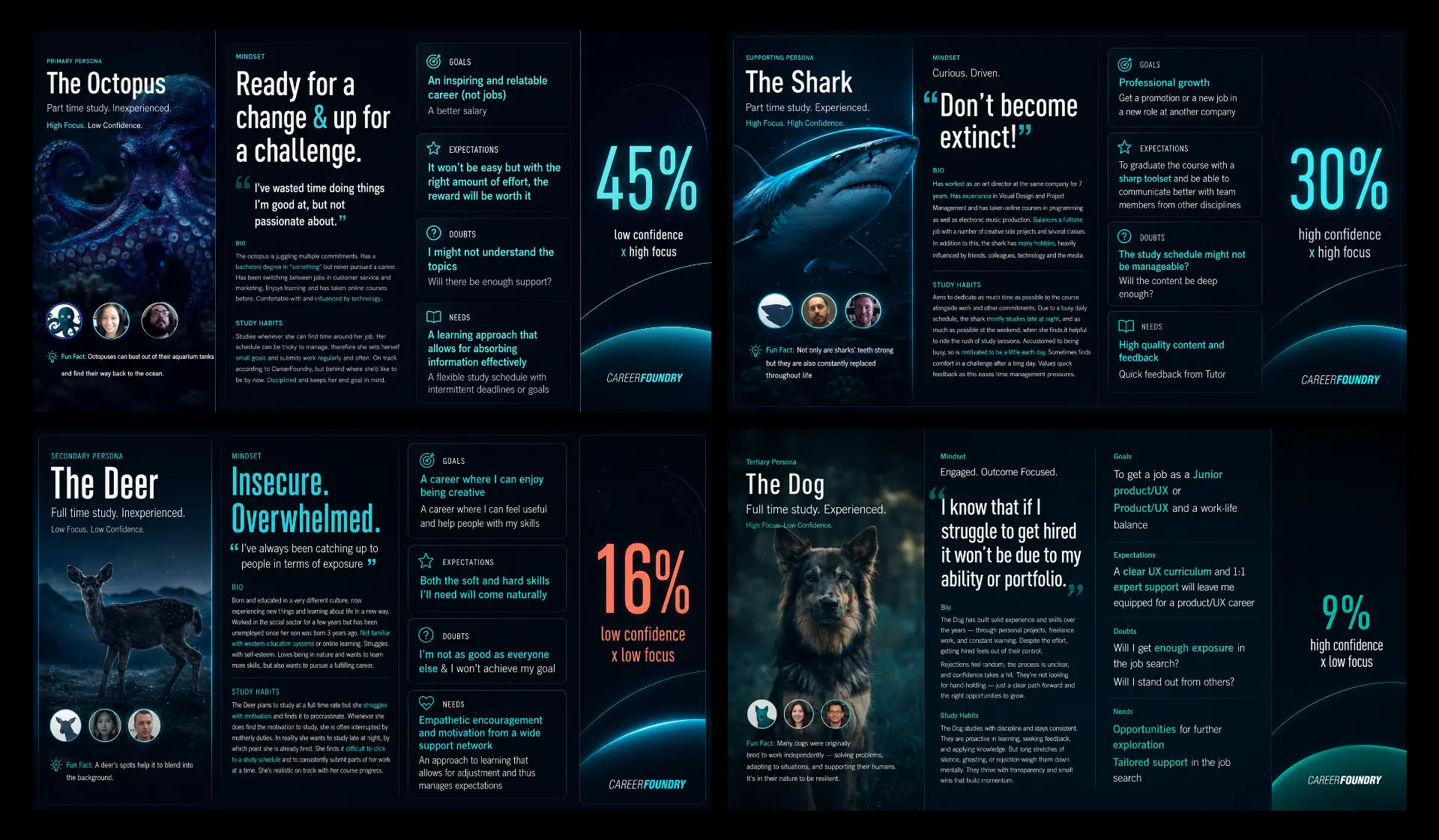
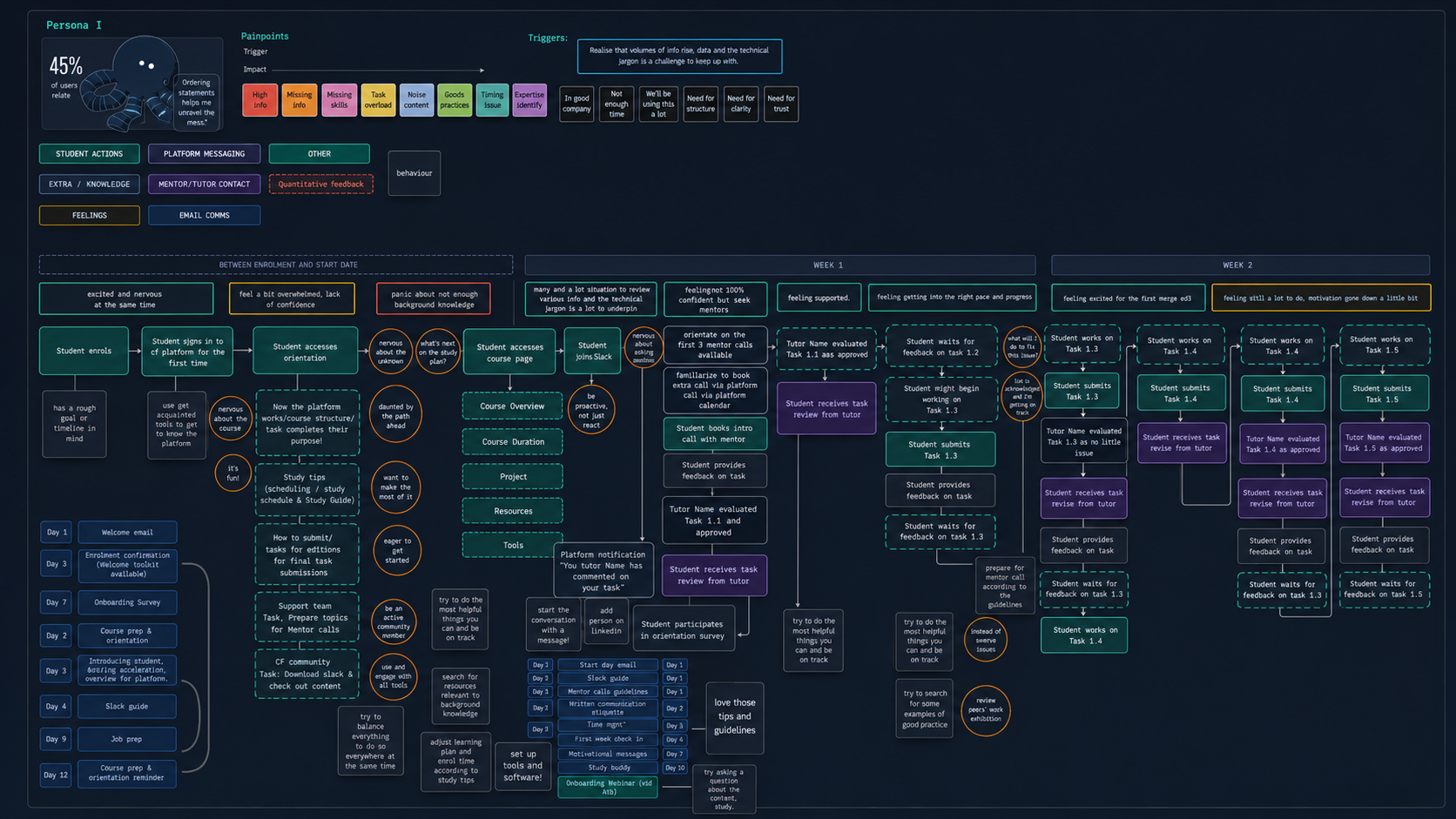
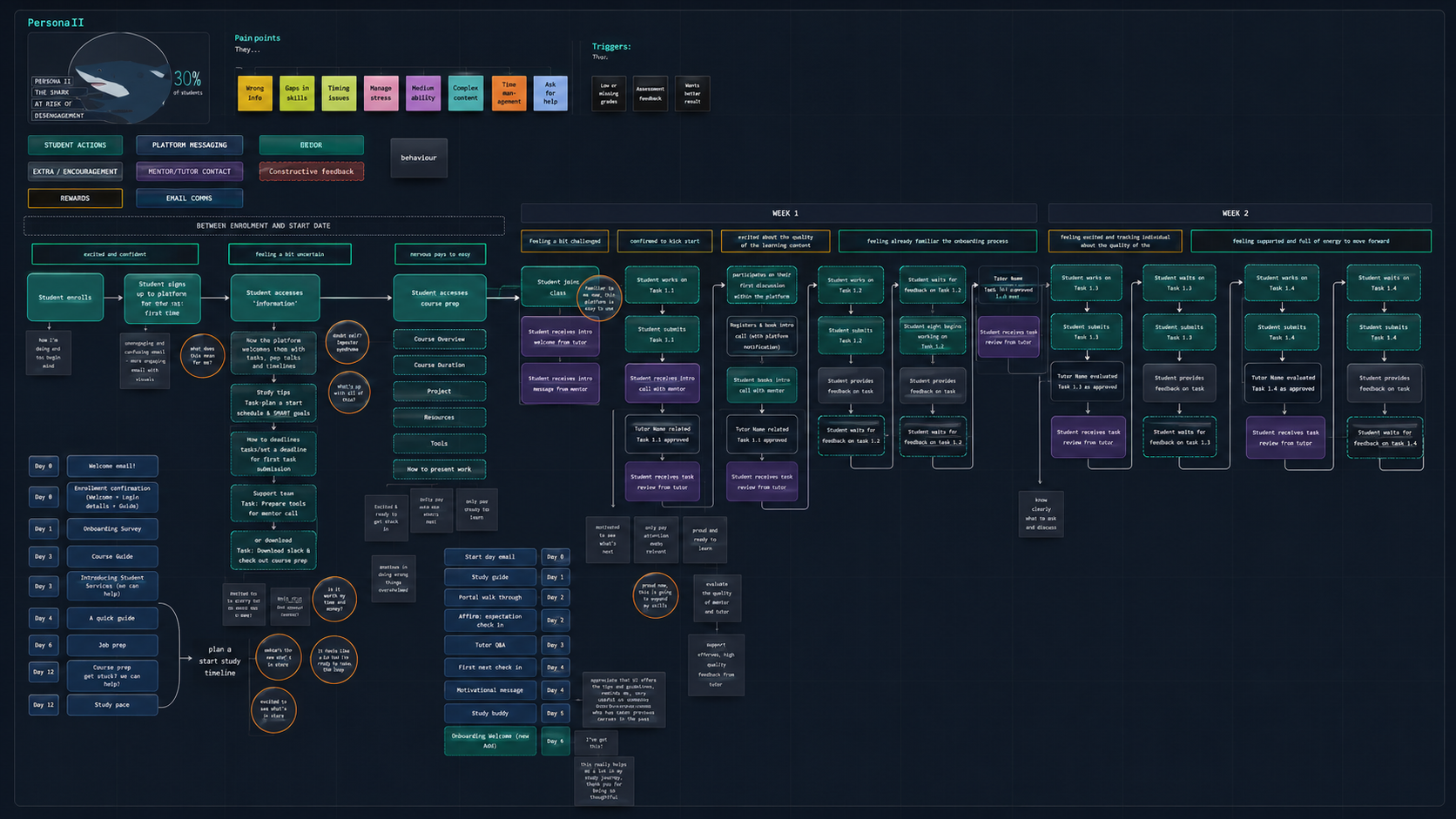
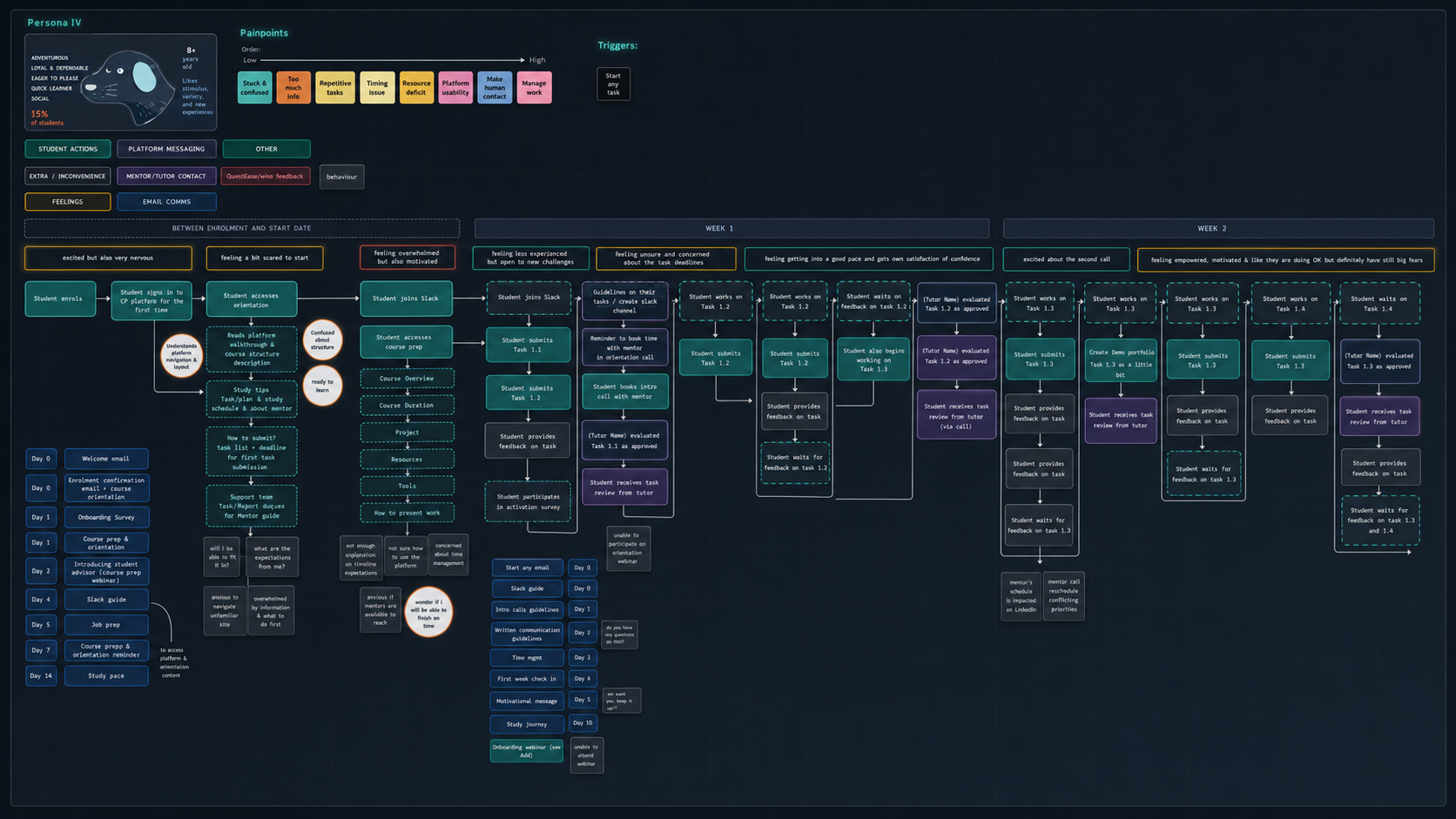
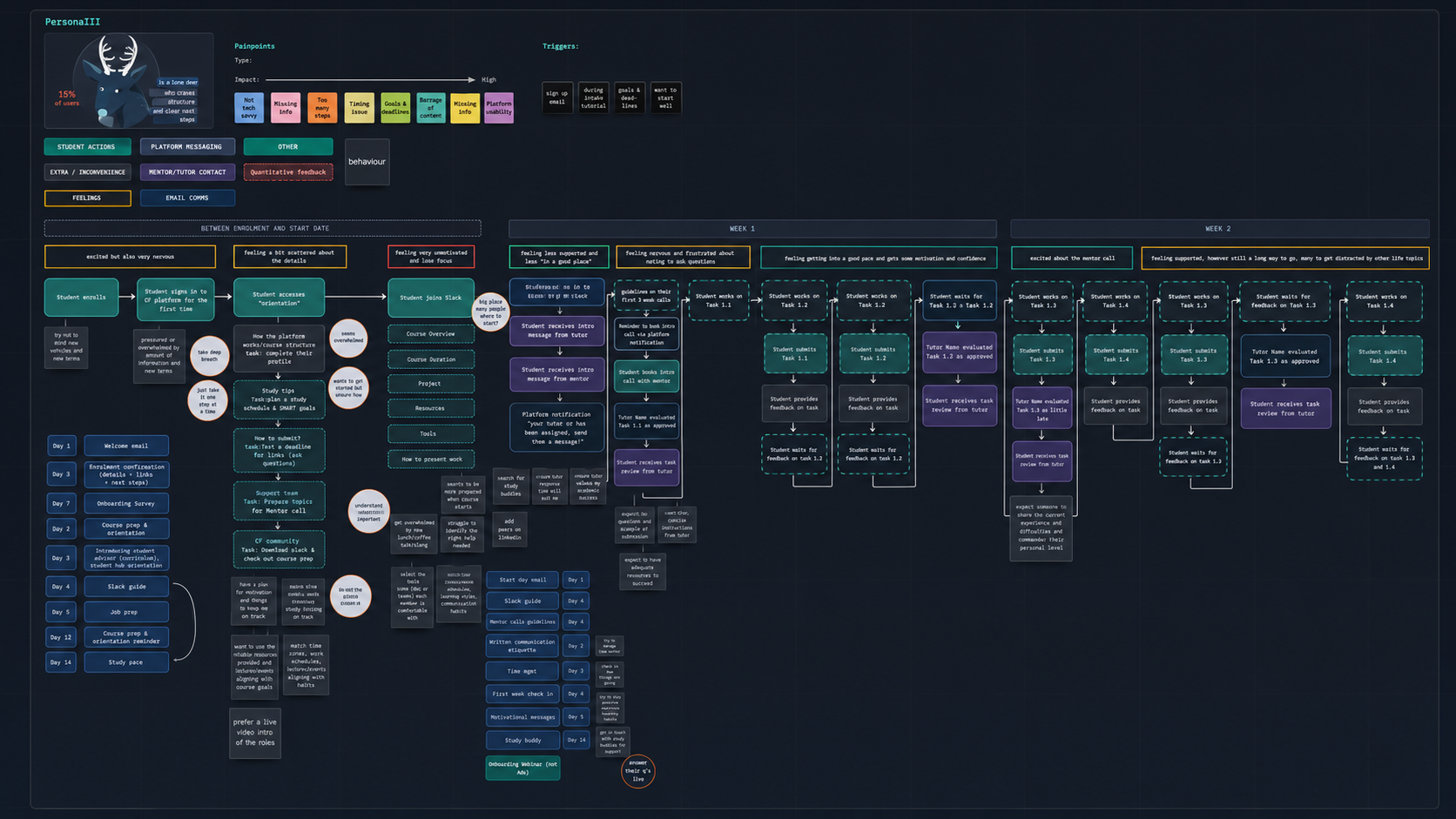
CareerFoundry had identified four broad student personas based on factors such as previous experience, motivation, available study time, and confidence. I mapped the onboarding journey for each persona, including key actions, questions and concerns, emotional highs and lows, product touchpoints, support needs, and potential intervention points.
Cross-functional ideation
I facilitated an ideation workshop with the Product Owner, engineers, and content stakeholders. The workshop was structured around the student journeys: team members identified opportunities at each stage and contributed ideas based on their area of expertise.
Then I ran a Crazy Eight brainstorming session with the team, so everyone had the opportunity to sketch their ideal solutions. Here are the 3 How Might We questions that I defined to open our creative thinking.
- How might we adapt onboarding to different career backgrounds?
- How might we introduce relevant guidance at the right moment?
- How might we help students build confidence and a routine early?
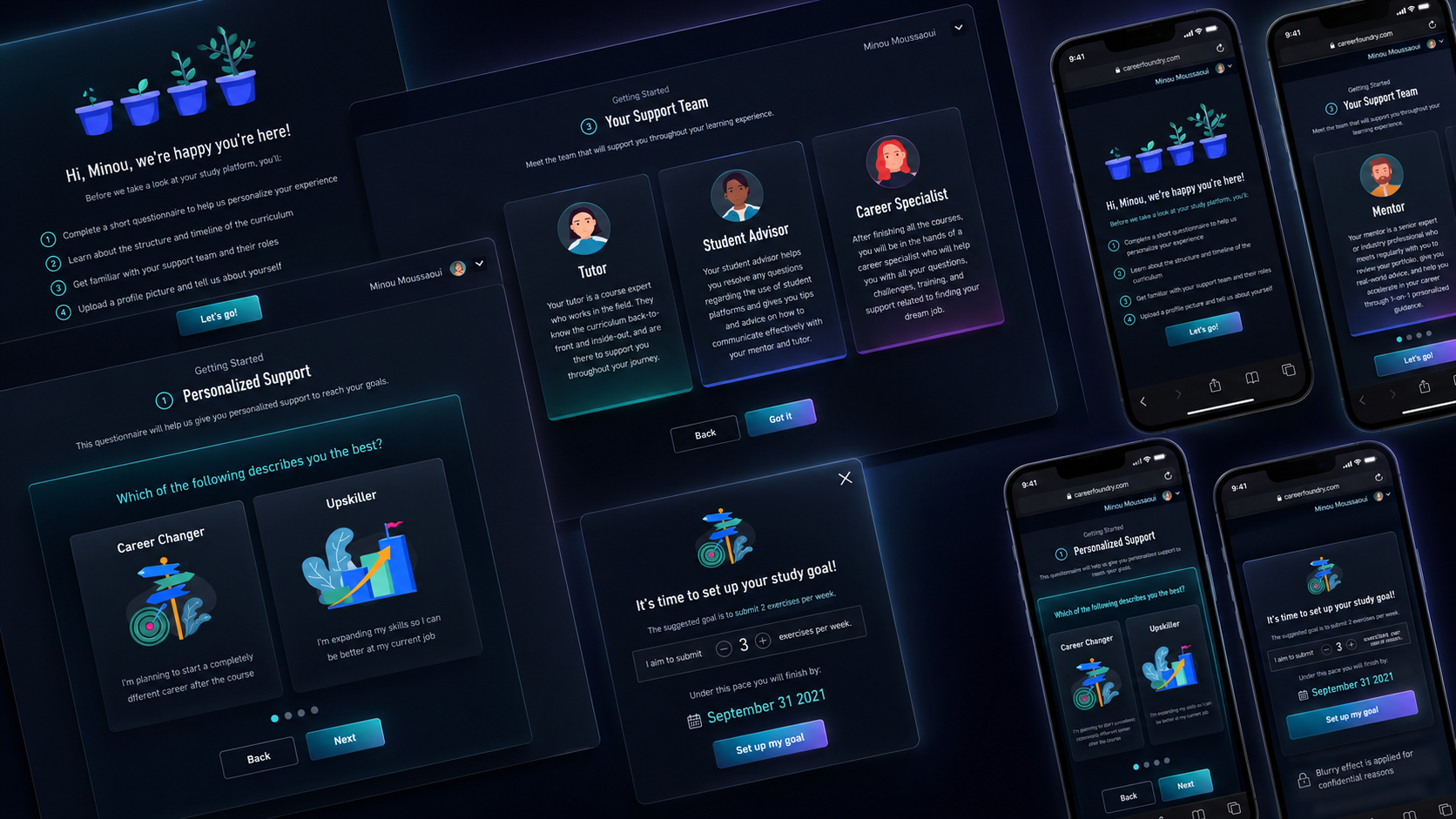
Opportunity mapping led us to rethink onboarding end-to-end. We prioritized ideas by impact and effort, choosing high-impact directions with realistic implementation effort for the first prototype: a short background survey, an interactive platform tour, a weekly study-time goal, an onboarding checklist, and a tool preparation page.
1. A personalized onboarding survey
The experience begins with a short survey that asks students about previous knowledge and professional experience, motivation for taking the course, weekly availability, confidence level, and learning goals.
The information could be used to tailor resources, set more realistic expectations, and provide better support throughout the course. The survey was intentionally concise — its role was not to create an extensive student profile, but to collect enough context to make the next steps more relevant.
Engagement principle When students understand why something is relevant to them, they are more likely to participate.
2. A contextual platform walkthrough
Instead of asking students to read a long onboarding document, the platform introduces essential features through short coach marks.
- Focuses on one useful action.
- Appears within the relevant interface.
- Uses concise, actionable language.
- Allows students to move forward or skip.
- Can be accessed again later.
The walkthrough helps students become familiar with the platform while actively using it. This reduces the gap between receiving information and applying it.
Engagement principle Action creates understanding and momentum more effectively than passive instruction.
3. A measurable study goal
We initially explored a personal weekly study-time goal alongside the preset submission target. The hypothesis was that greater ownership could build confidence and a routine. Testing challenged this: two goals created more mental load, and students wanted control over their progress rather than another goal to manage.
We replaced the two-goal model with one adjustable weekly submission goal. CareerFoundry recommends a target based on the pace needed to stay on track; students can increase or reduce it, with the expected graduation date updating transparently. They can adjust their goal again as circumstances change.
Engagement principle Give students control over the pace — while keeping the consequences clear.
PROTOTYPING & TESTING
From wireframe to usability test
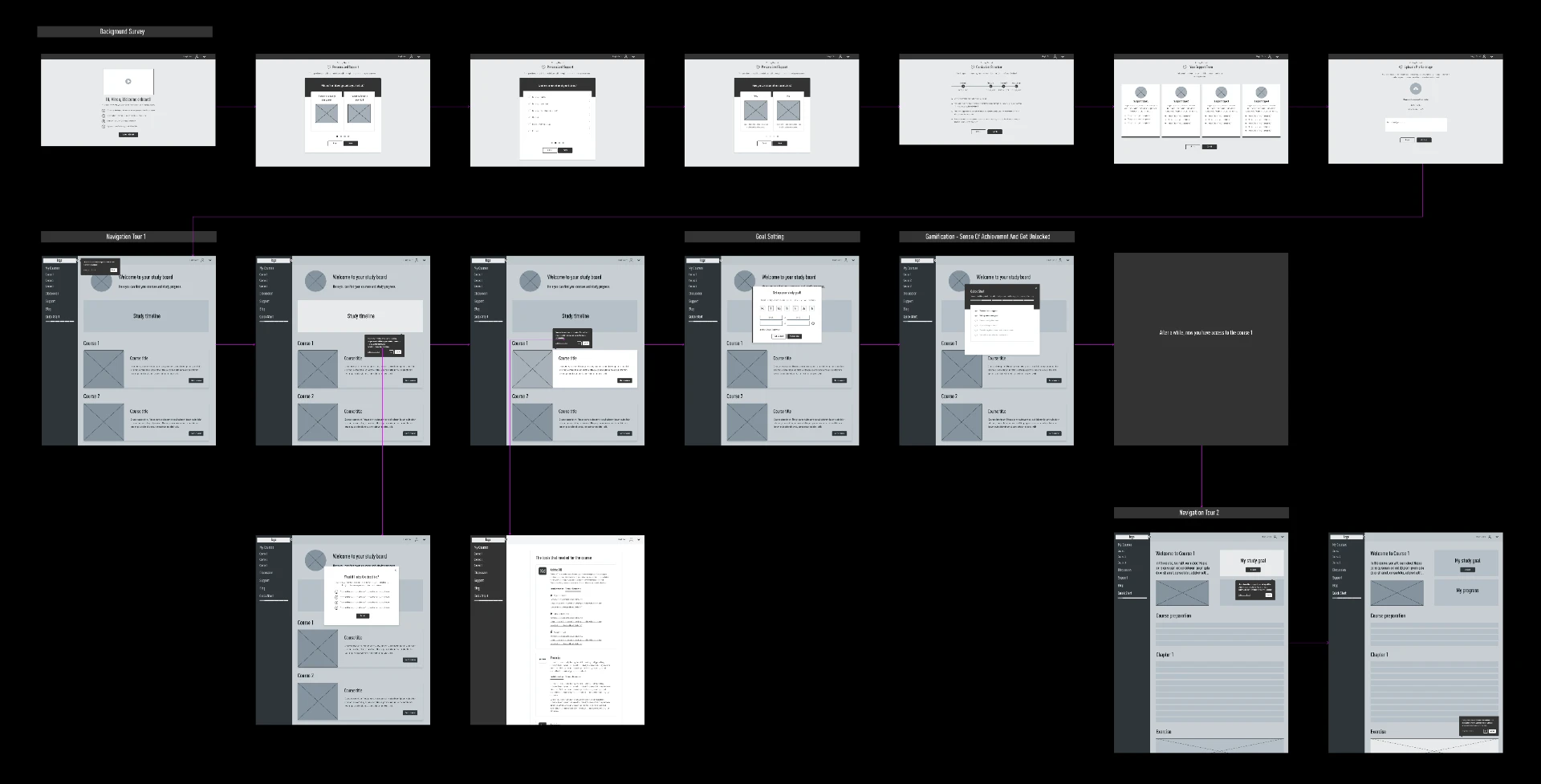
Based on the workshop outcomes, I created a wireframe connecting the background survey, contextual platform tour, tool preparation, goal setting and onboarding checklist.
We tested the logic before polishing the UI through moderated usability sessions via UsabilityHub with 6 current students across UX Design, Web Development and Data Analytics.
- Utility: did the experience address students' most important onboarding needs?
- Learnability: could students understand the walkthrough and navigation without explanation?
- Efficiency: could they find the information and complete the actions quickly?
- Effectiveness: did they remain engaged throughout the flow, or did they attempt to skip it?
- Satisfaction: did the experience help them feel welcomed, prepared, and confident?
What we learned
1. Personalization felt valuable. The short background survey helped students feel heard before they started learning.
2. Tool preparation reduced anxiety. Setup support was especially helpful for UX Design students new to the field.
3. Two goals created more mental load. A personal study-time goal alongside the preset weekly submission goal made planning more complex. Students wanted more control over their progress, not another goal.
4. Gamification slowed students down. Progress mechanics competed with what students actually wanted: to start learning.
ITERATION
Removing everything that delayed learning
- Removed the onboarding checklist and gamification. Progress mechanics no longer distracted students from starting their course.
- Removed the separate weekly study-time goal. Students had one flexible submission goal rather than two competing targets.
- Let students set and adjust their own weekly submission goal. The recommended pace remained visible, and a slower pace transparently moved the expected graduation date.
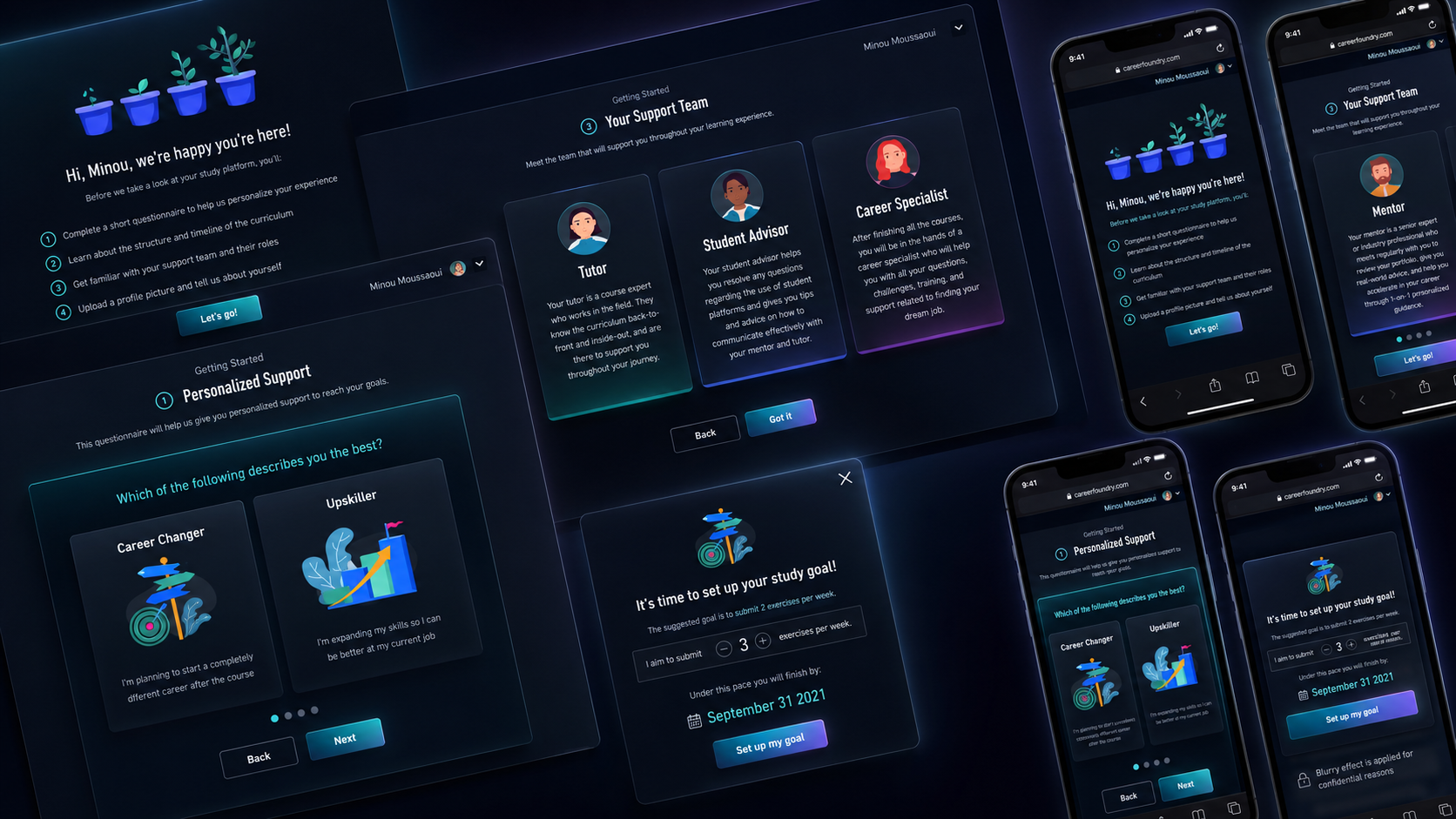
We revised the interaction model, built a high-fidelity interactive prototype and ran 10 moderated usability tests with CareerFoundry students via UsabilityHub. The core onboarding sequence and updated goal-setting model were understood clearly, giving us confidence to move into final design.
DELIVERY & COLLABORATION
Engineering involved at every stage
Context was shared continuously, not transferred at the end. By build, engineering already understood the problem, evidence, design decisions and trade-offs. Their input helped simplify the logic for self-adjusted weekly submissions, while content and curriculum stakeholders rewrote guidance for different student personas and made the tool preparation section possible.
- Figma design file — final screens, components and specifications.
- Interactive prototype — flows and interaction behavior.
- Interaction specification — a spreadsheet covering complex UI behavior, states and edge cases.
- QA checklist — created with the Product Owner.
OUTCOME
Outcomes measured over the following quarter
Our primary outcome was an approximately 17% increase in first-month student On Track rate — the team's key measure of learning momentum. Supporting metrics showed improvements in preparation, confidence and earlier learning actions.
- Onboarding completion: 13.2% → 37.5% completed all recommended onboarding activities.
- Confidence: 3.2/5 → 4.1/5 average confidence in meeting the weekly submission goal.
- First submission: 4 → 3.25 days average time to first task submission.
The project transformed onboarding from a passive collection of instructions into a focused product experience. Rather than explaining everything at once, the redesigned flow helped students understand the platform through direct interaction, receive essential information in context, prepare the tools needed for their course, set a practical and measurable study goal, and begin learning with greater clarity and confidence.
Just as importantly, the process aligned product, engineering, curriculum, content, and analytics around a shared definition of successful student onboarding.
REFLECTIONS
Key takeaways
1. Engagement starts with meaningful action. Students didn't need to spend longer in onboarding. They needed to understand, get ready, start learning, build a routine and stay on track.
2. Better decisions came from different perspectives. Students challenged our assumptions around goals and gamification. Engineering simplified the submission-goal logic, and curriculum experts made preparation content useful for different backgrounds.
3. Give students control with clear consequences. One adjustable submission goal reduced mental load while making the effect on the expected graduation date transparent.
4. Use AI to accelerate learning, not replace product judgment. AI wasn't part of my original workflow. Today, I'd use it to synthesize research while checking raw evidence, challenge hypotheses while prioritizing with evidence, and build functional prototypes to test behavior earlier.
Engagement isn't about getting people to use a product more. It's about helping them achieve what they came for.
Disciplines
- Product strategy
- user research
- journey mapping
- workshop facilitation
- UX/UI design
- prototyping
- usability testing
Next project
Inu Health →