ROLE
Founder, Product & Design Lead
TIMELINE
2025/2026
CONTRIBUTIONS
0→1 Product Strategy, Product Design, Brand & Narrative, Public Pitching, Partnerships
OUTCOME
A live baby sleep product in Apple Store and Googleplay, an initial organic user base and a validated roadmap for further product development
Summary
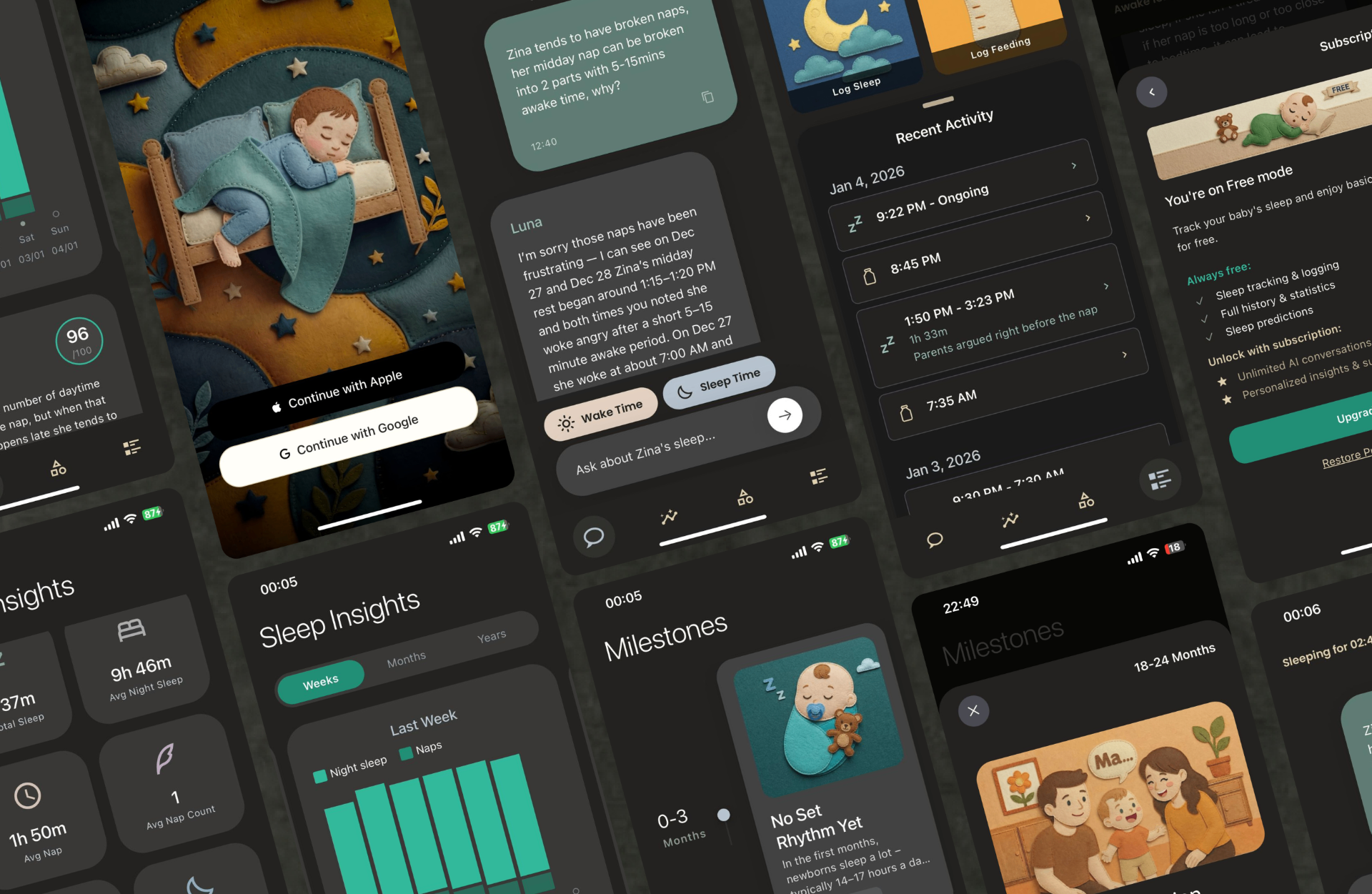
Numi grew from my experience as a first-time mother trying to understand my daughter’s sleep. I built it to turn fragmented sleep data and advice into clear, personalised guidance for parents.
Download the app: https://numicare.app/
DISCOVER
From personal experience to a validated problem
The initial idea was inspired by my own experience as a first-time mother. I encountered an overwhelming amount of contradictory sleep advice, while the products available to me mainly helped me record what had already happened. They did not help me understand why my baby’s sleep was changing or how I should respond.
However, I did not treat my personal experience as evidence that the opportunity was broadly relevant. I used it as the starting hypothesis for discovery. I took the following steps:
- A parent survey with 100 participants
- 10 qualitative interview sessions
- Competitive and market analysis
- Casual conversations with parents about their sleep-related decisions
- Interviews with baby sleep specialists
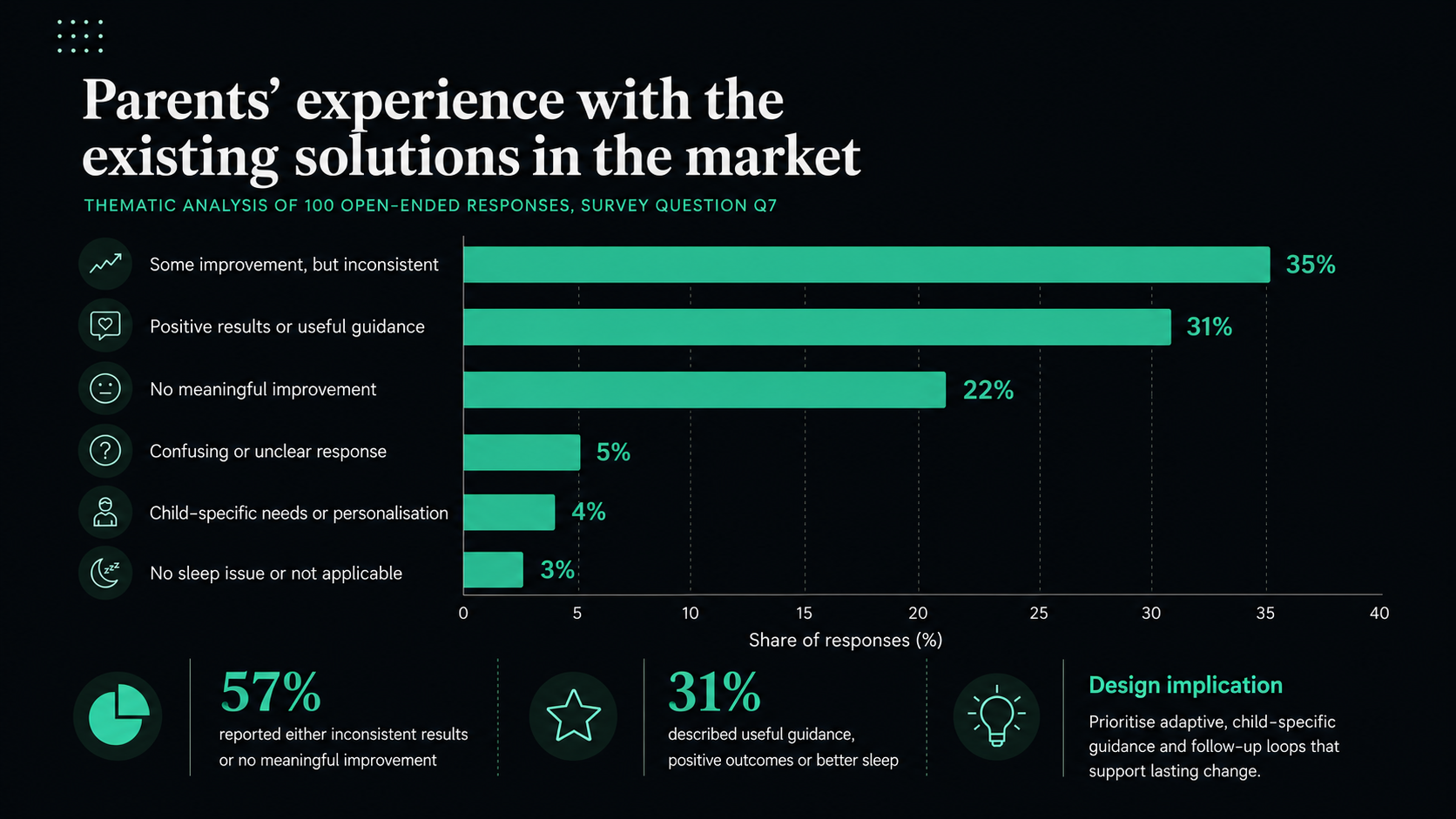
This helped me distinguish between my personal frustration and the recurring needs shared by a wider group of parents.
What I learned
Parents were not primarily asking for more sleep data. They wanted help answering questions such as:
- Is this sleep pattern normal for my child’s age?
- Why has my baby suddenly started waking more often?
- Should I change the nap schedule or wait?
- What should I do exactly under a certain situation?
- How do I know whether a change is helping?
- When should I seek professional or medical support?
The strongest need was not tracking. It was interpretation, reassurance and decision support.
I therefore identified three recurring gaps in the existing experience:
1. Tracking without interpretation
Parents could record what happened, but they still had to determine what the patterns meant.
2. Advice without context
Articles and standard sleep schedules could not account for a child’s age, recent sleep, routines, environment or developmental changes.
3. Support without continuity
Professional support could be valuable, but it was not available continuously and was often financially inaccessible.
Core job to be done
Help parents move from recording sleep to understanding it, and from uncertainty to a practical next step.
Numi’s user personas
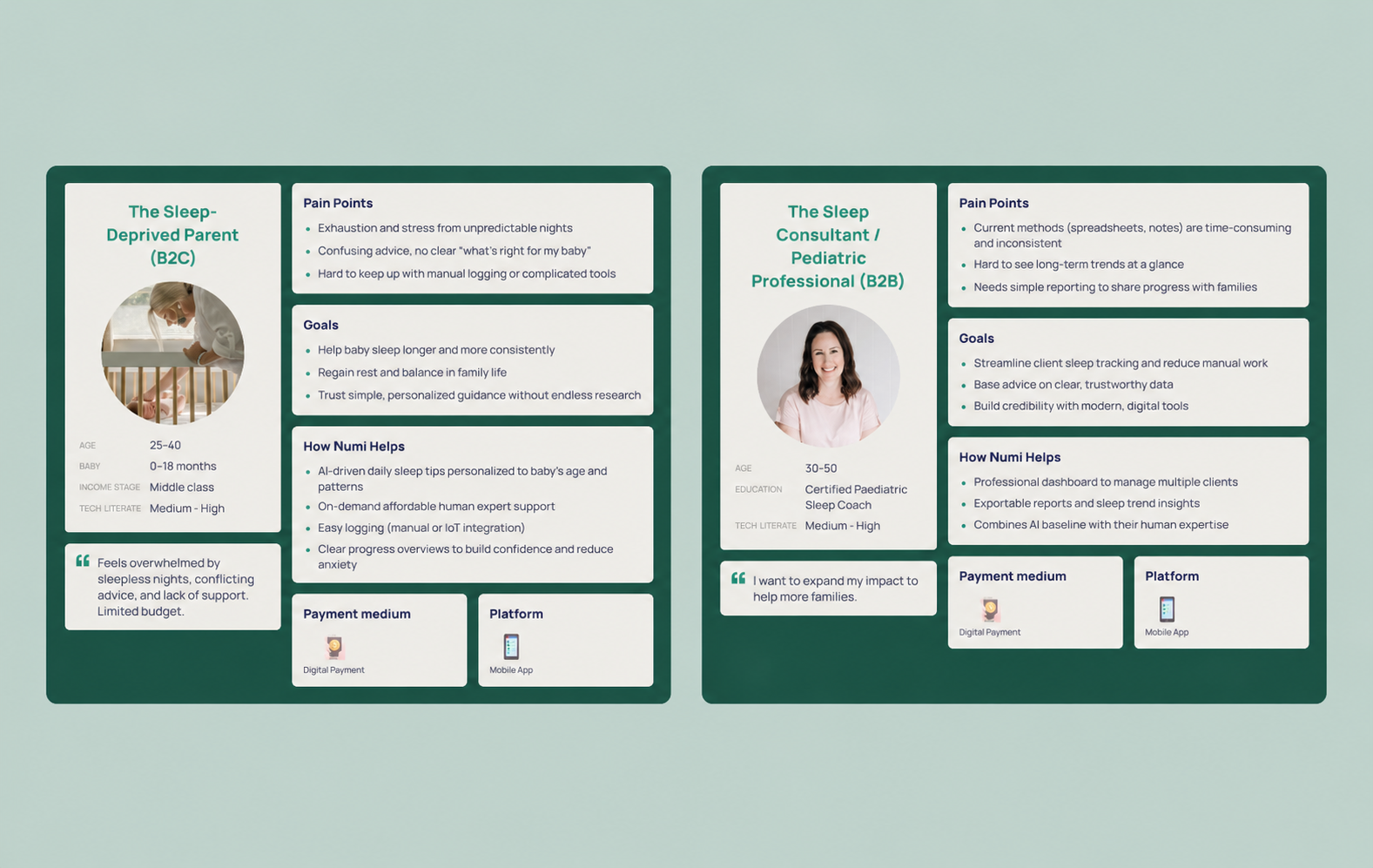
Based on insights from user interviews and surveys, I created three core personas representing Numi’s primary users. Because the product also offers in-app human support, I included a dedicated consultant persona to reflect the needs of baby sleep specialists using the platform.
PRODUCT VISION & PRINCIPLES
Personalised sleep guidance that adapts with the child
Give every parent access to personalised, trustworthy sleep guidance that adapts as their child grows.
The product would combine sleep tracking, developmental context and conversational support in one continuous experience. Instead of simply showing parents charts, Numi would help them understand the patterns behind those charts and translate them into practical next steps.
Guidance over tracking
Every piece of data should contribute to an explanation, recommendation or decision. Tracking should have a clear benefit for the parent rather than becoming an administrative task.
Explain, do not command
The product should explain why it is making a suggestion rather than presenting advice as an instruction. Parents should remain in control of the final decision.
Personalise support
Every piece of advice and every insight should be tailored to the individual child, using their sleep patterns, age, routines, and recorded data as context.
Support, do not judge
Many parents already feel pressure around their child’s sleep. The language should reduce anxiety and avoid framing normal sleep difficulties as parental failure.
Design for exhausted users
The experience needed to remain understandable when used at night, under stress or with limited attention. Logging, navigation and guidance had to be simple and immediately actionable.
AI with clear boundaries
The product should distinguish between educational sleep guidance and medical advice. It should acknowledge uncertainty and direct parents to professional support when appropriate.
MVP Prioritisation
From a broad family-support vision to a focused MVP
The original opportunity space was large — sleep prediction, feeding support, room-condition analysis, developmental milestones, human coaches and connected sensors. Building all of these at once would have made it difficult to validate whether the central proposition was valuable.
So I narrowed the MVP around one core behavioural loop that could deliver value early and give us something meaningful to validate:
Record what happened → understand the pattern → receive contextual guidance → try an adjustment → observe the result.
Included in the first product
- Child profile and developmental context input via onboarding
- Sleep and nap logging
- Feeding logging
- Sleep-history overview
- Pattern-based insights
- Conversational AI support
- Contextual sleep guidance
- Developmental milestone content
- Basic recommendation and follow-up flows
Prioritised for later validation
- More proactive sleep predictions
- Advanced recommendation personalisation
- Environmental room assessment
- Human sleep-coach escalation
- Connected sensors and smart-home integrations
- Broader parenting and developmental support
The challenge was not adding a chatbot
A generic conversational interface would not be sufficient. Parents needed the AI to understand their child’s recent sleep, identify relevant patterns, ask for missing information and provide practical guidance — without sounding overly certain or clinical. It also needed to work for parents who did not know what question to ask.
How might we make AI guidance feel contextual and useful while preserving clarity, trust and parental agency?
1. Collect context
- Child’s age
- Recent naps and night sleep
- Wake times
- Feeding information
- Parent-reported routines
- Current concerns
- Developmental stage
2. Identify patterns
- Changes in total sleep
- Long or short wake periods
- Shifting nap timing
- Repeated night waking
- Irregular bedtime patterns
- Recent developmental transitions
3. Explain what may be happening
Instead of immediately offering instructions, the AI first helps the parent understand the possible relationship between the data and the current difficulty.
4. Recommend a practical, actionable next step
The guidance focuses on a small, manageable adjustment rather than overwhelming the parent with a full programme.
5. Follow up and adapt
The product can ask whether the suggestion helped and use new information to refine future guidance.
How Numi’s AI learns
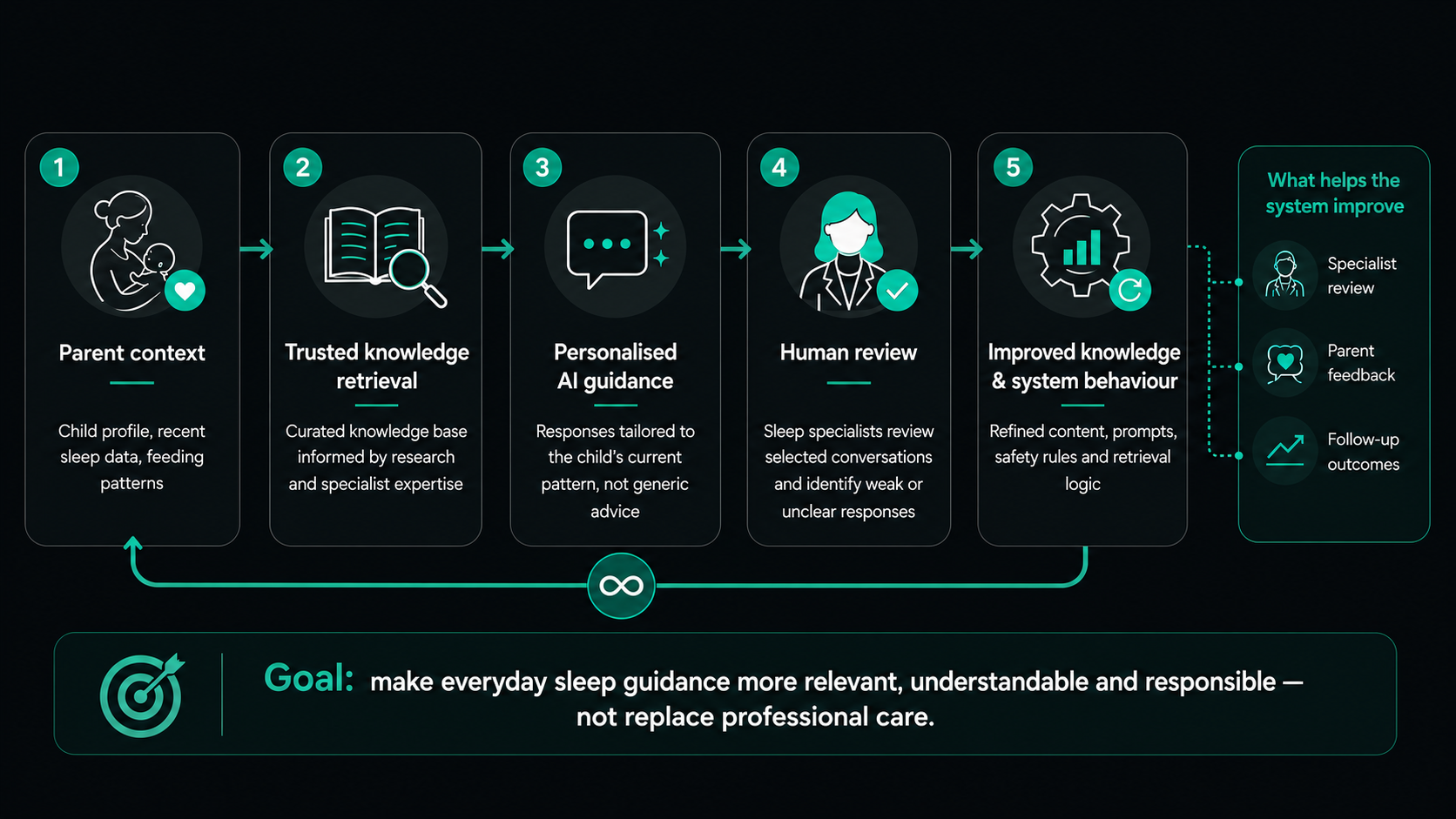
Numi combines retrieval-augmented generation with human-in-the-loop review to provide guidance that is personalised, grounded and continually improving.
When a parent asks a question, Numi brings together relevant information from the child’s profile, recent sleep and feeding data, and a curated knowledge base informed by sleep research and specialist expertise. The AI uses this context to generate a response tailored to the child’s current pattern rather than relying on generic advice.
Human review strengthens the system over time. Sleep specialists evaluate selected conversations, identify weak or unclear responses, and improve the underlying content, prompts, safety rules and retrieval logic. Parent feedback and follow-up outcomes also help reveal where the guidance is useful and where it needs refinement.
This creates a continuous learning loop:
Parent context → trusted knowledge retrieval → personalised AI guidance → human review → improved knowledge and system behaviour
The goal is not to replace professional care, but to make everyday sleep guidance more relevant, understandable and responsible.
DELIVERY
Leading from ambiguity to implementation
As both product lead and designer, I continuously balanced parent needs, product differentiation, AI capabilities and limitations, engineering complexity, budget, timelines, trust and long-term business potential — translating research and strategy into user flows, prioritised requirements and delivery trade-offs.
Working with engineers
I used AI-native tools Cursor and Lovable to rapidly prototype product surfaces directly from natural-language specs. This shortened the gap between design and implementation, while I still applied rigorous UX critique to evaluate AI-generated flows, conversational experiences, and interaction quality before they moved forward.
Working with specialists
I sought input from baby sleep specialists to improve the product’s guidance, language and boundaries — distinguishing between information that could be provided safely and situations that required professional escalation.
Roadmap leadership
I maintained a roadmap connecting feature development with the questions the product still needed to answer:
- Does personalised interpretation create more value than tracking alone?
- Which types of guidance lead to repeated use?
- How much information do parents need before they trust a recommendation?
- When is AI support sufficient, and when is human support more appropriate?
- Which features increase retention rather than only initial interest?
- What are parents willing to pay for?
Outcome
From personal frustration to a live product
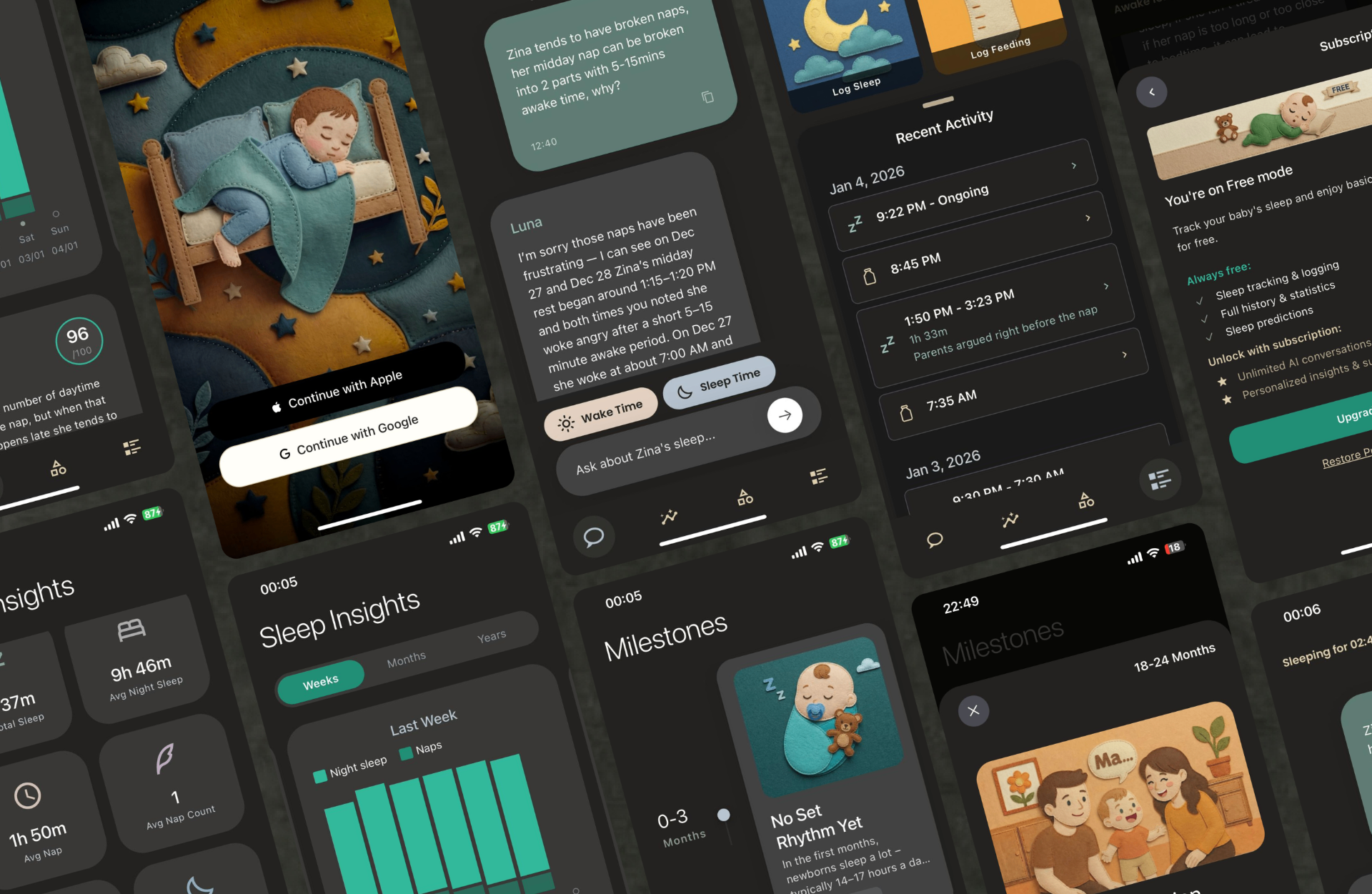
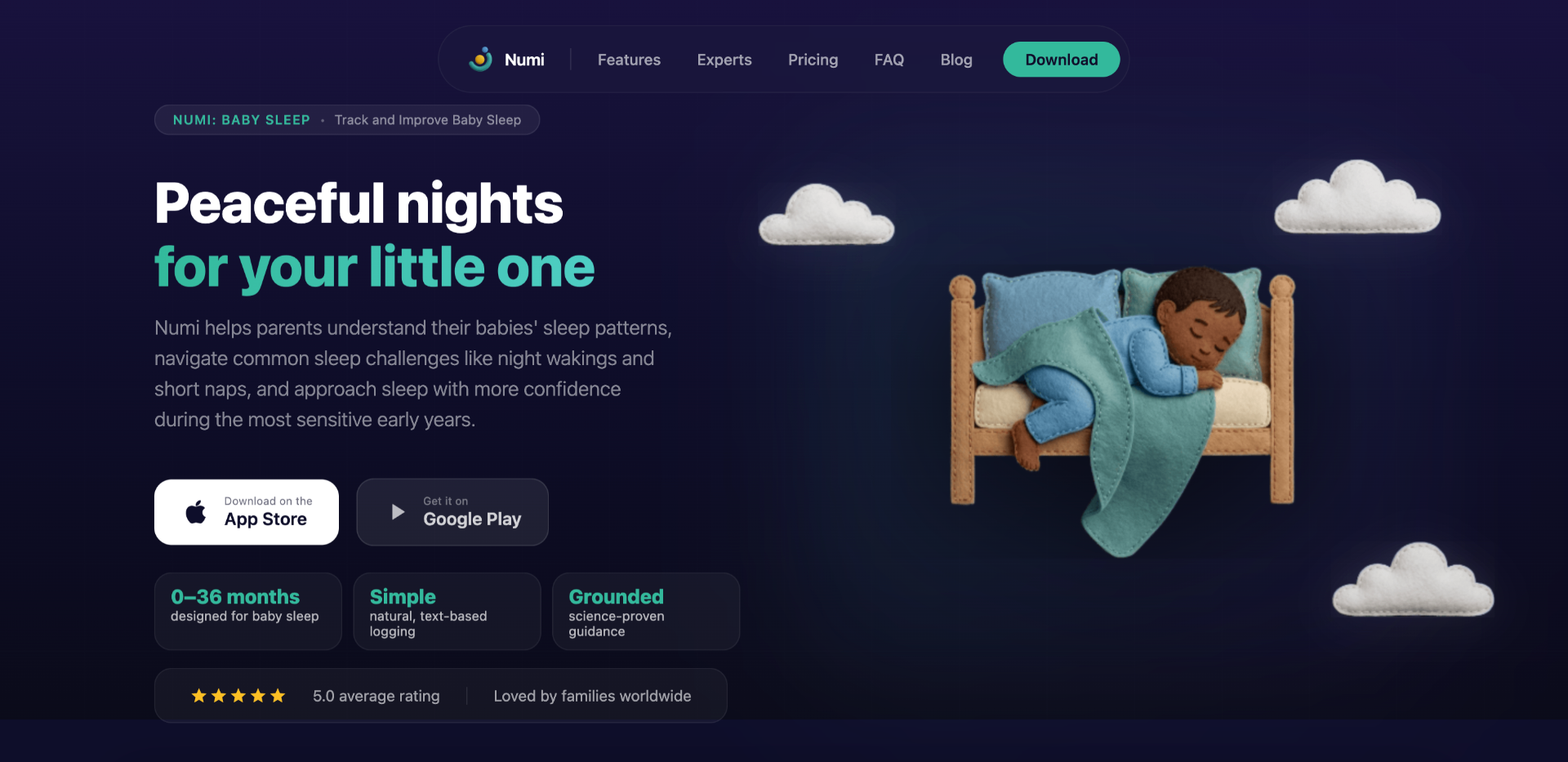
Numi progressed from an initial personal frustration to a live mobile product available to real users on iOS and Android.
Early results
- Approximately 150 early organic users 3 months after launch
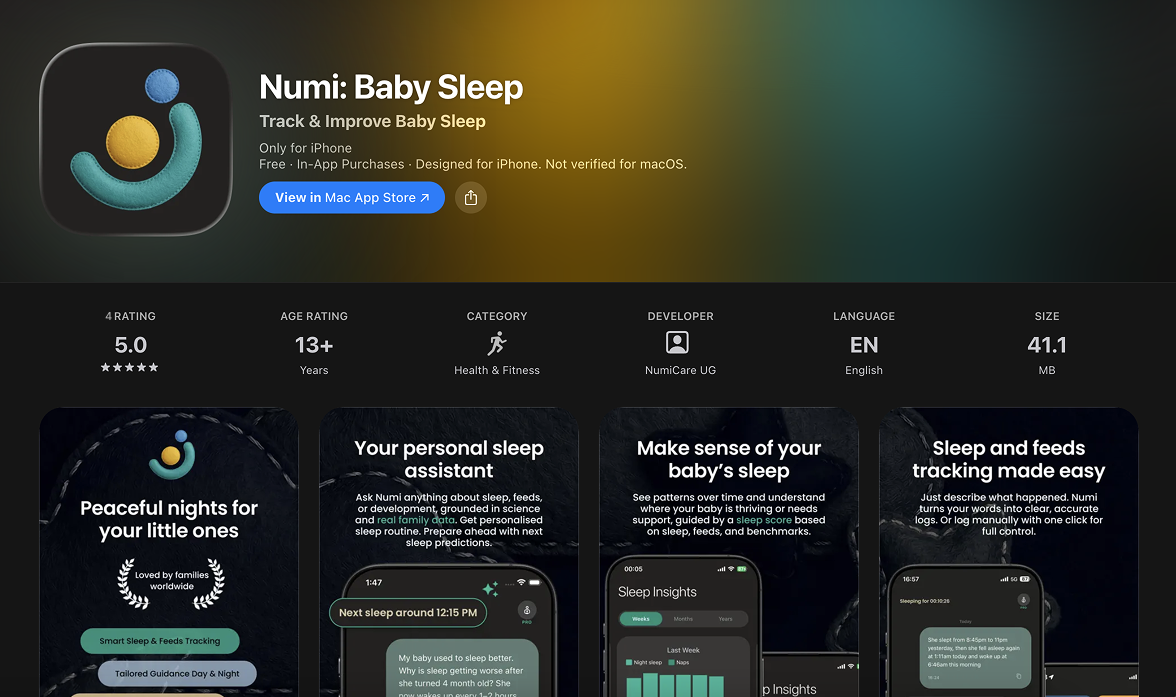
- Eight 5 stars app stores reviews across 3 countries
- Ten user interviews with 4/5 satisfactory rating.
Reflections
AI value depends on product context
Conversational capability alone does not create a valuable AI experience. The quality depends on whether the AI has enough relevant context, communicates its reasoning clearly and helps the user make a meaningful decision. For Numi, value came from connecting conversation with recorded behaviour, developmental information and a clear follow-up loop.
Trust is a design outcome
Trust could not be added through a disclaimer alone. It was reflected in the language, recommendation structure, level of certainty, product boundaries and the relationship between data and guidance — resisting the temptation to make the AI sound more confident than the available information justified.
Focus is essential in zero-to-one work
The potential scope was much broader than what could be responsibly validated in the first release. Prioritising a focused guidance loop created a coherent MVP and made it possible to test the central proposition.
Leadership required moving between levels
I regularly moved between strategic, design and delivery decisions — defining the value proposition, then reviewing a microinteraction, clarifying logic with an engineer or deciding which feature to remove from the release.
Public Storytelling
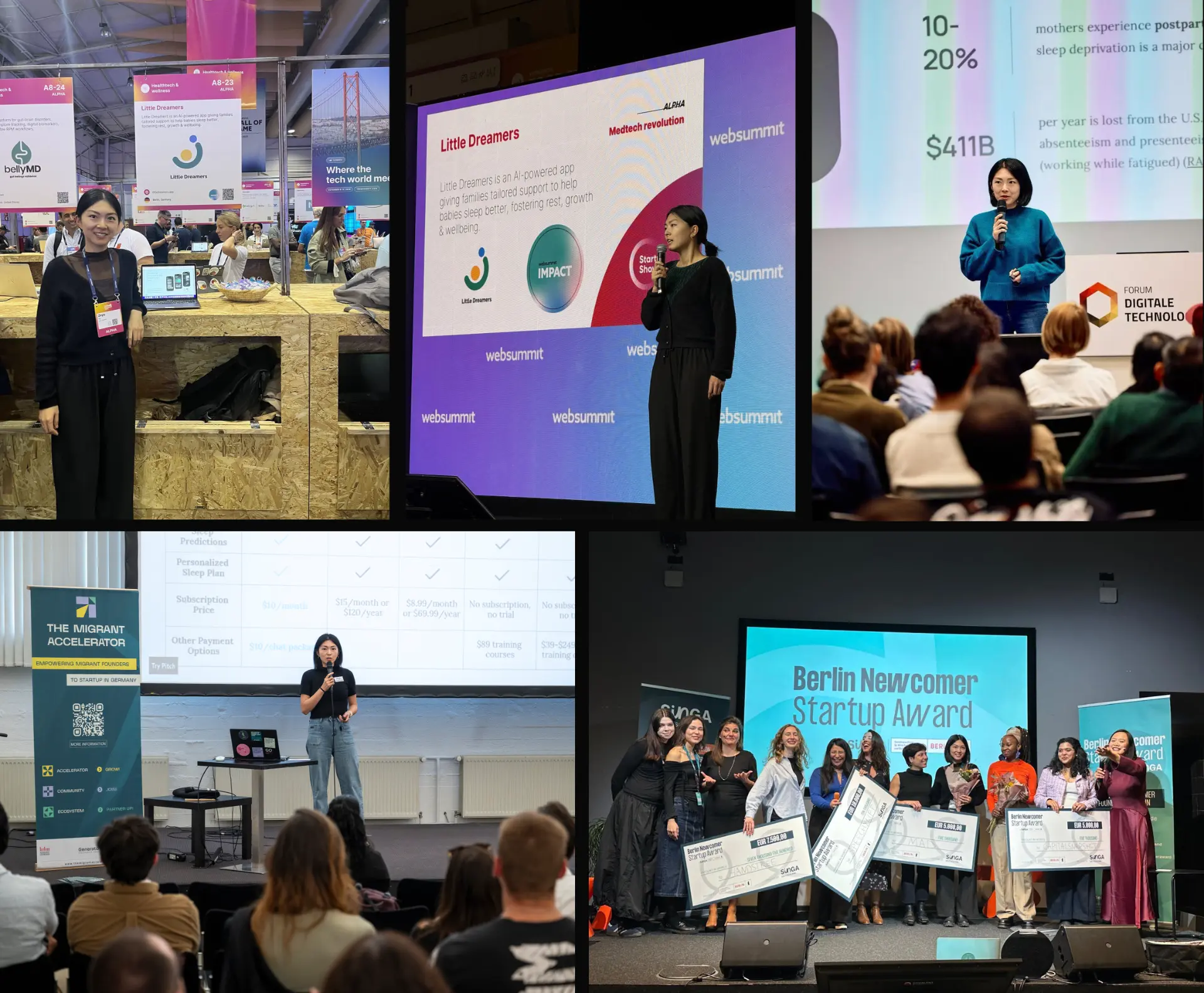
Building Numi stretched me well beyond product and design. In its earlier life as Little Dreamers, I pitched the idea to audiences, investors, and accelerator communities. That work earned a place in Web Summit's ALPHA program and a slot pitching at Web Summit itself. Little Dreamers went on to join The Migrant Accelerator's Spring 2025 batch, which I closed out with a pitch at Demo Day, and reached the stage at the SINGA Berlin Newcomers Startup Award as one of six finalists. I was also invited to host a public session at Venture Café on parenting in the age of AI.
Putting my own experience on stage taught me to tell a clear story, hold an audience's attention, and speak with conviction about a problem I know from the inside. It also taught me not to flinch from the difficult parts. The things I was most hesitant to say out loud were often the ones that opened real conversations afterward.
Disciplines
- 0 TO 1 PRODUCT STRATEGY
- PRODUCT DESIGN
- BRANDING & STORYTELLING
- PUBLIC PITCHING
- BUILDING WITH AI
Next project
Building a scalable Design System →